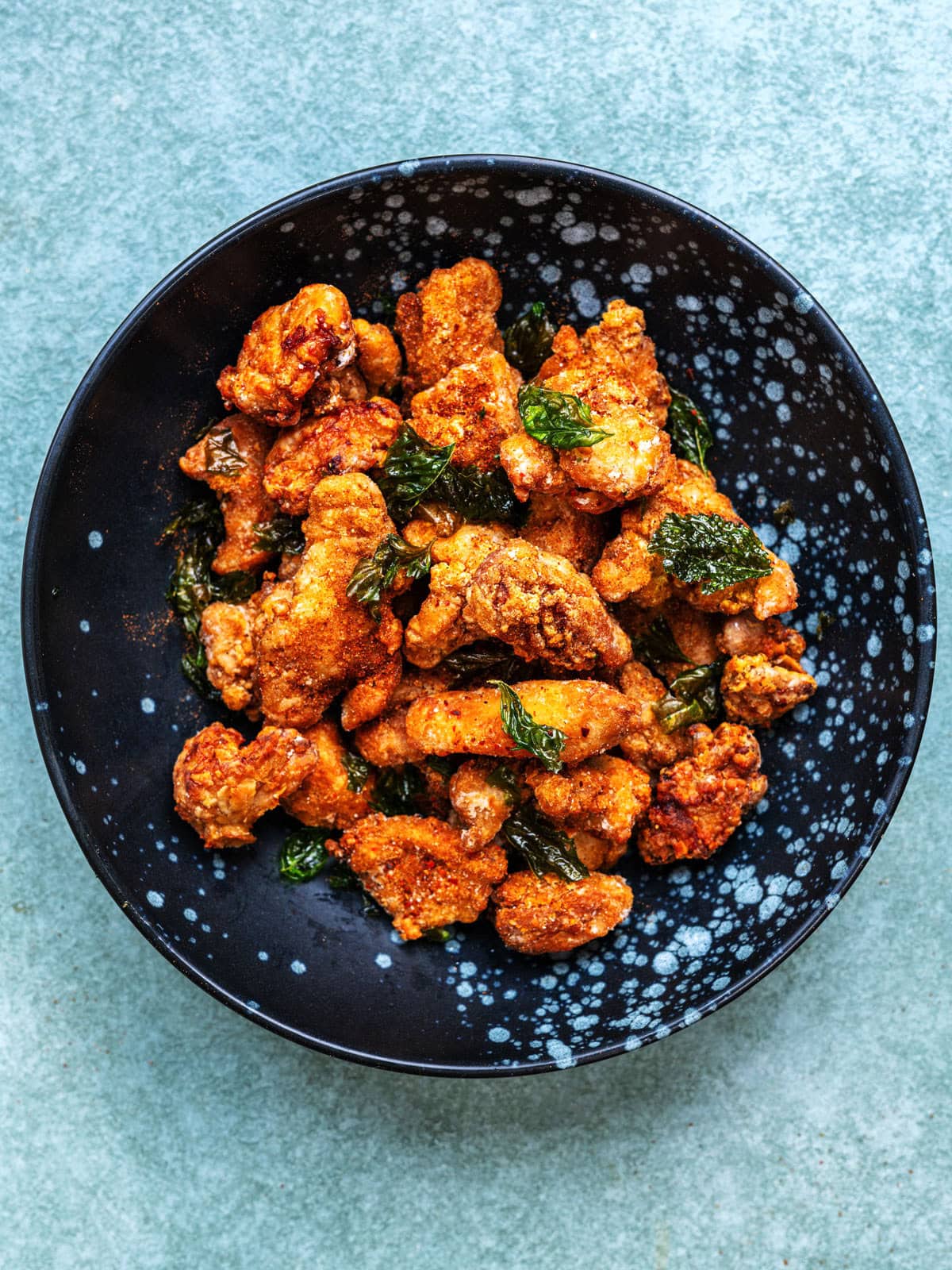
Taiwanese Fried Chicken
Crispy Taiwanese fried chicken – the bite-size night market snack known as yan su ji, or Taiwanese popcorn chicken. Five-spice marinated chicken thighs in a craggy sweet potato starch coating, deep fried or made in the air fryer.
Servings: 4
Calories: 965kcal
Equipment
Ingredients
For the marinade
- ¼ cup (60ml) light soy sauce , low sodium
- 1 tbsp Shaoxing wine , optional
- 2 tsp Chinese five spice
- 1 tsp granulated sugar
- ½ tsp white pepper
- ¼ tsp chicken powder (optional)
- 2 cloves garlic minced
- 1 tsp grated ginger
- 1 large egg white See Note 1
For the chicken
- 2 lb (900g) chicken thighs boneless and skinless (6 to 8 thighs)
- 3 cups (360g) sweet potato starch See Note 2
- neutral oil , to fry, as needed
For the seasoning powder
- 2 tsp Chinese five spice
- 1 tsp sugar
- ½ tsp mild chili powder , or hot, up to you
- ¼ tsp white pepper
To serve
- handful Thai basil leaves (optional)
Instructions
Marinate the chicken
- Whisk the soy sauce, Shaoxing wine, five spice, sugar, white pepper, chicken powder, garlic and ginger together in a bowl, then stir in the egg white.¼ cup (60ml) light soy sauce, 1 tbsp Shaoxing wine, 2 tsp Chinese five spice, 1 tsp granulated sugar, ½ tsp white pepper, ¼ tsp chicken powder, 2 cloves garlic, 1 large egg white, 1 tsp grated ginger
- Cut the chicken thighs into bite-size pieces, roughly 1 inch (2.5cm), trimming off any fatty bits.2 lb (900g) chicken thighs
- Add the chicken and mix well. Cover and marinate for at least 30 minutes, or up to 8 hours in the fridge.
Coat in sweet potato starch
- Put the sweet potato starch in a wide bowl. Lift the chicken out of the marinade a few pieces at a time and toss in the starch, pressing it on so every side is coated.3 cups (360g) sweet potato starch
- Set the coated pieces on a tray and leave them for 5 to 10 minutes, until the starch looks damp rather than powdery. This is what stops the coating falling off in the oil.
To fry
- Heat 2 inches (5cm) of neutral oil in a wok or deep pan to 350°F (175°C). Fry the chicken in batches for 4 to 5 minutes, turning now and then, until deep golden and cooked through (165°F / 74°C in the middle).neutral oil
- Lift onto a rack to drain, and let the oil come back up to temperature before you fry the next batch.
- Once all the chicken is fried, pat a handful of Thai basil leaves completely dry and drop them into the hot oil for 3 to 5 seconds, until they turn crisp and translucent. Lift them out quickly with a spider strainer and drain on paper towels, then scatter over the seasoned chicken.handful Thai basil leaves
To make it in the air fryer
- Preheat the air fryer to 400°F (200°C). Mist the coated chicken with oil using a spray bottle until no dry patches of starch are visible.
- Cook in a single layer, in two batches, for 15-18 minutes, shaking the basket once or twice, until the chicken golden and cooked through (minimum 165°F / 74°C in the middle when checked with a thermometer). Please note you cannot fry the basil leaves in the air fryer – the air will suck them into the heating element!
Season and serve
- Mix the five spice, sugar, chili powder and white pepper for the seasoning powder in a small bowl.2 tsp Chinese five spice, 1 tsp sugar, ½ tsp mild chili powder, ¼ tsp white pepper
- Tip the hot chicken into a large bowl, sprinkle over the seasoning powder and toss well. Serve straight away garnished with fried Thai basil (see notes).
Notes
- Note 1: You don't have to use the egg white but it helps the starch stick to the chicken. If you are leaving it out, make sure the chicken has enough moisture in the marinade.
- Note 2: Coarse sweet potato starch is what gives the craggy, night market crust. Potato starch or tapioca starch is the next best thing; cornstarch (cornflour) works but fries up smoother.
Saving and reusing the frying oil
- Don’t throw the oil away – you can fry with it two or three more times. Let it cool completely in the pan, then strain it through a fine mesh sieve lined with a coffee filter, a piece of cheesecloth or a double layer of paper towels. The little bits of starch left behind are what make oil darken and taste stale, so it's worth straining carefully.
- Pour the strained oil into a clean, dry jar or bottle, seal it and label it with the date and what you fried in it. Kept in a cool, dark cupboard it will be fine for about a month; in the fridge it keeps for up to 3 months (it may turn cloudy when cold, which is normal – it clears as it warms up). Use it for savory frying rather than doughnuts, as it carries a little of the five spice and chicken flavor with it. Throw it out when it has darkened noticeably, smells sharp or rancid, foams up around the food, looks thick and syrupy or starts smoking at a lower temperature than usual.
- Never pour it down the sink – let it set, or soak it up with paper towels, and put it in the bin, or take larger amounts to a household recycling center.
Nutrition
Calories: 965kcal | Carbohydrates: 106g | Protein: 48g | Fat: 39g | Saturated Fat: 10g | Polyunsaturated Fat: 8g | Monounsaturated Fat: 16g | Trans Fat: 0.2g | Cholesterol: 222mg | Sodium: 1086mg | Potassium: 1769mg | Fiber: 8g | Sugar: 7g | Vitamin A: 264IU | Vitamin C: 6mg | Calcium: 130mg | Iron: 5mg
