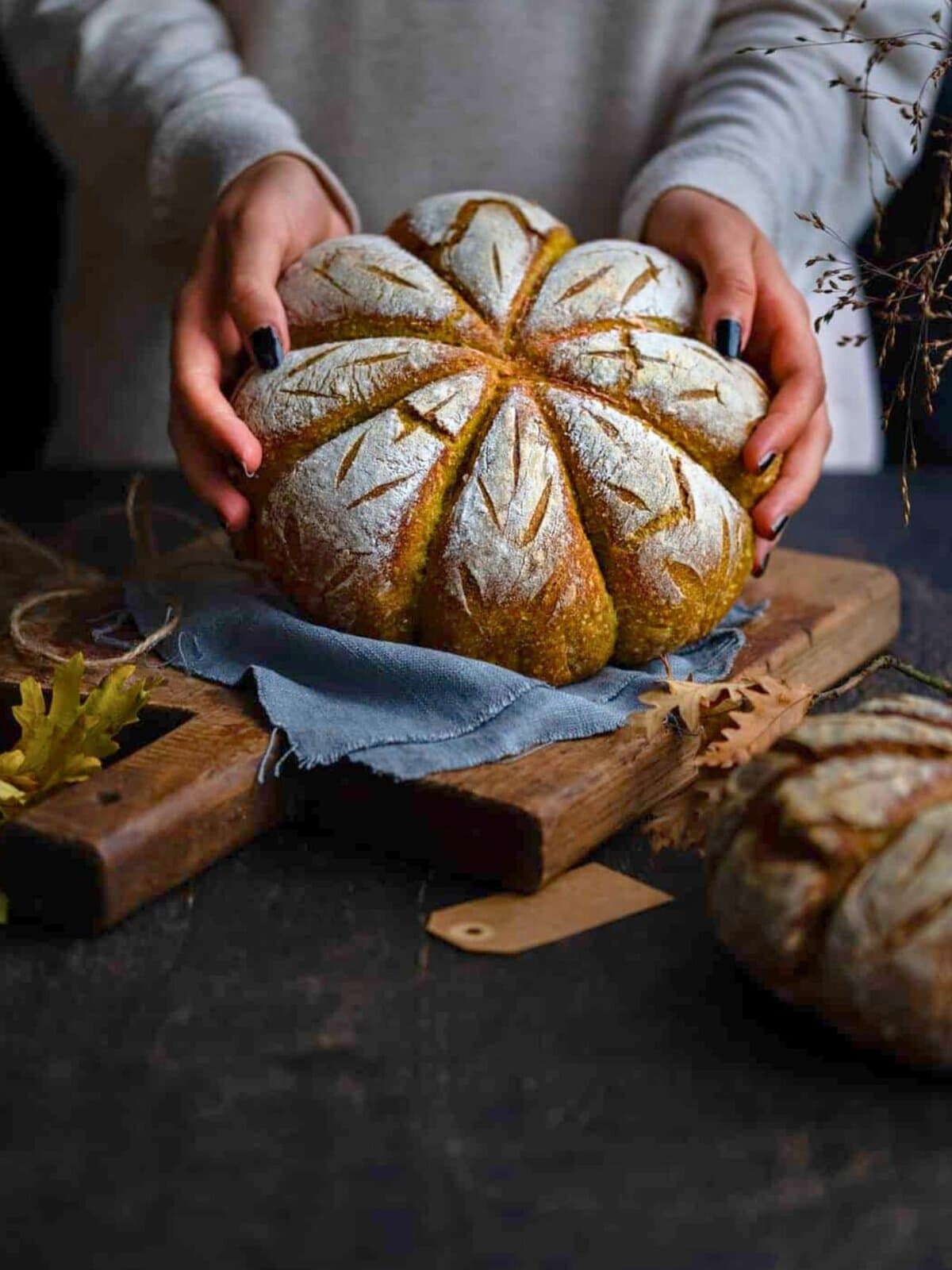
Pumpkin Sourdough Bread
This Pumpkin Sourdough Bread is fragrant with spices, subtly sweet and shaped like a pumpkin! A fun and easy (I promise!) sourdough bread recipe that’s perfect for Fall.
Servings: 12 slices
Calories: 173kcal
Equipment
Ingredients
For your starter
- scant ¼ cup (50g) mature starter room temperature
- ⅓ cup + 1 tbsp (50g) flour
- 3 ½ tbsp (50g) tepid water (filtered, bottled, or boiled and cooled to room temperature)
For the sourdough loaf
- 3 ½ oz (100g) active starter (most of the starter you prepared earlier)
- 1 ¼ cups (300g) water (filtered, bottled, or boiled and cooled to room temperature)
- 3 ½ oz (100g) canned pumpkin purée
- 3 tbsp honey or maple syrup
- 1 tbsp pumpkin spice
- ½ tsp ground turmeric optional – for color only, see notes
- scant 2 tsp sea salt
- 4 cups (500g) white bread flour , more as needed
- olive oil for greasing the bowl, as needed
- olive or vegetable oil for the string, as needed
- rice flour or gluten free flour for the bowl or banneton, as needed
Instructions
Feed Your Sourdough Starter
- Feed your mature starter. Leave for 4-6 hours, or until doubled in size, bubbly and floating in water (float test).scant ¼ cup (50g) mature starter, ⅓ cup + 1 tbsp (50g) flour, 3 ½ tbsp (50g) tepid water
Prepare The Dough
- Mix the starter and water together in a large bowl. Add the pumpkin purée, spices, salt and honey and mix well.3 ½ oz (100g) active starter, 1 ¼ cups (300g) water, 3 ½ oz (100g) canned pumpkin purée, 3 tbsp honey or maple syrup, 1 tbsp pumpkin spice, ½ tsp ground turmeric, scant 2 tsp sea salt
- Add the bread flour and mix well with the dough whisk or your hands. It’s easier to have a feel for the dough if you use your hands. You will have a shaggy, slightly sticky dough. Cover the bowl and leave to rest for half an hour.4 cups (500g) white bread flour
Stretch and Fold
- Pull a section of the dough from the underside and stretch it upwards. Fold this over the rest of the dough. Rotate the bowl as you do this so you stretch the entire dough. You can do this a few times – every 30 minutes for two hours or just the once.olive oil
- Transfer the dough into an oiled bowl, cover and leave to rise either at room temperature for 8-10 hours, or in the fridge for 10-14 hours. Watch the dough rather than the clock: it should rise by about half to double, look domed and jiggly, and show bubbles at the edges. A warm kitchen will get there considerably faster.
Shape The Sourdough
- The following day take a look at your dough - it should have almost doubled. Mist your worktop with water and scrape the dough onto it – do not punch the dough down. Gently stretch the dough to form a rectangle.
- Fold into three sections, like a letter. Roll the dough into a tight ball.
- Flip over, seam side down, and shape into a round loaf (known as a “boule”). Use your hands and a bench scraper to roll the loaf in your hands, slightly tucking the edges under as you go (please check the video for a demo).
Second Rise
- Line a bowl or basket with baking paper and lightly dust the paper and your loaf with gluten free flour or rice flour to prevent the bread from sticking to the paper. Cup the loaf in your hands and place into the prepared bowl seam side down.rice flour or gluten free flour
- Leave the dough to rise again for 30-120 minutes – dough that has come from the fridge is cold and will need the longer end. Check your dough is ready to bake by gently prodding with a finger. If the indent springs back slowly leaving a small dent then you are ready to bake. If it springs back really quickly you need to allow it to rise for a little longer.
Shape your loaf
- Cut four pieces of 100% cotton butcher’s twine, about 24 inches (60cm) long. Soak them in vegetable oil for a full 10 minutes rather than just dipping them, leaving about 2 inches (5cm) at each loose end out of the oil, then run them between your fingers to strip off the excess. Position the strings on top of a round piece of parchment paper (cut so that it fits your Dutch Oven), crossing them at the center.olive or vegetable oil
- Turn the loaf out onto the strings rather than lifting it – hold the parchment over the mouth of the banneton and flip the whole thing over in one movement so the loaf lands in the middle of the strings. Bring the strings up over the loaf and tie them loosely, leaving about ¾ inch (2cm) of slack so the bread can expand as it bakes, so that it is divided into eight equal sections.
- Cut any excess string, then score the loaf. Score within the lobes rather than across the strings – a cut that crosses a string will tear as the bread expands. One shallow cut down the middle of each section works well. Keep the cuts shallow; deep scoring fights the string.
Bake your Sourdough
- Preheat your oven to 450°F (230°C) with the Dutch oven inside, for a full 45-60 minutes. Cast iron takes longer than you think to heat right through, so start the preheat well before the end of the second rise.
- Remove the pot from the oven using pot holders (please be very careful). Place the loaf into the pot, lifting it by the baking paper.
- Cover and bake for 30 minutes. Reduce the temperature to 425°F (220°C), take the lid off and bake for a further 15-20 minutes – until the crust is deep golden and the internal temperature in the center of the loaf reaches 205-210°F (96-99°C). Start checking the temperature at 15 minutes. If the crust darkens before the temperature is there, tent it loosely with foil and keep baking.
- Leave the bread to cool, uncovered, for at least 2 hours before you cut it – the crumb carries on setting as it cools, and slicing a warm sourdough will make even a perfectly baked loaf feel gummy. Remove the strings and boast about your pumpkin shaped sourdough!
Video
Notes
Bake to temperature, not to time. Pumpkin purée and honey are both sugar-rich, so the crust browns well before the crumb is set. The center of the loaf should read 205-210°F (96-99°C). Under 200°F (93°C) is not done.
Cool it completely. The crumb carries on setting as the loaf cools, so give it a minimum of two hours before slicing.
Turmeric is optional and is there for color only – a small amount is plenty, and you can leave it out altogether.
Using a Banneton Basket
If you are using a banneton basket (you need to prep this first before first use) dust the basket with rice or gluten free flour, shaking out some of the excess.
Carefully transfer your loaf seam side up in this case. Cover with a bag and leave to rise. When the dough is ready to bake, after the second rise, carefully invert onto baking paper then proceed to bake in a Dutch Oven.
Homemade pumpkin purée needs to be thick enough to sit on a spoon rather than pour off it. Line a sieve with a double layer of cheesecloth and let it drain for 20-30 minutes, and hold back 2-3½ tablespoons (30-50g) of the water until you see how the dough handles.
Storing Sourdough Bread
Cover the cooled loaf in a clean tea towel and store at room temperature – the bread will keep for 2-3 days. I prefer to slice the entire loaf and then freeze it – that way you can toast slices directly from frozen whenever the fancy takes you.
Cover the cooled loaf in a clean tea towel and store at room temperature – the bread will keep for 2-3 days. I prefer to slice the entire loaf and then freeze it – that way you can toast slices directly from frozen whenever the fancy takes you.
Nutrition
Calories: 173kcal | Carbohydrates: 35g | Protein: 6g | Fat: 1g | Saturated Fat: 1g | Sodium: 390mg | Potassium: 47mg | Fiber: 1g | Sugar: 1g | Calcium: 6mg | Iron: 1mg
